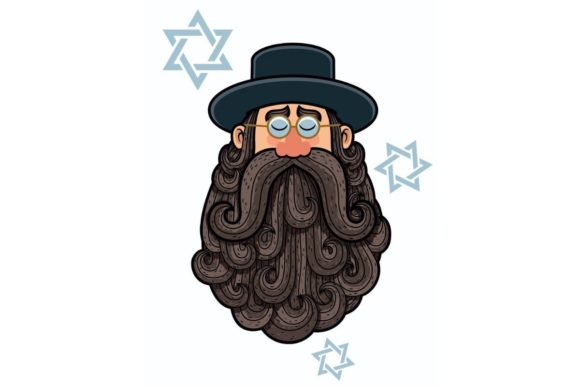
Rabbi Portrait: A Cartoon Illustration for Creative Projects
When you're building a brand or designing a piece of marketing collateral, finding the right visual asset is often the most challenging part of the process. You need something that communicates personality, establishes tone, and connects with your audience—all without overwhelming the rest of your design. That's where a well-crafted illustration like Rabbi Portrait comes in. It's a cartoon-style character illustration depicting a rabbi with a distinctive, full beard, rendered in a style that balances warmth with professional polish.
What makes this particular asset worth discussing isn't just its subject matter. It's the versatility packed into a single download. The Rabbi Portrait illustration arrives as a ZIP archive containing multiple file formats: CDR for CorelDRAW users, AI for Adobe Illustrator workflows, EPS for broad vector software compatibility, SVG for web and digital applications, and a high-resolution JPEG at 300ppi for print-ready projects. That range of formats means you're not locked into a single design tool or output method, which matters more than most people realize when they're juggling multiple projects across different platforms.
Where This Illustration Fits Into Real Design Work
Think about the kinds of projects where a character illustration with religious or cultural significance would genuinely add value. Website headers for community organizations, synagogue newsletters, educational brochures about interfaith topics, event posters for holiday celebrations, greeting cards, blog post graphics, social media content for cultural awareness campaigns—these are all practical, everyday applications where Rabbi Portrait would feel right at home.
The cartoon style is important here. It's approachable without being juvenile, which is a difficult balance to strike. Many designers struggle when they need to represent religious figures or cultural icons because the line between respectful and caricature is thin. A cartoon illustration that's been thoughtfully designed sidesteps that problem by establishing its own visual language. The big beard, for instance, becomes a recognizable design element rather than a stereotype—it's part of the character's identity within the illustration's own stylistic framework.
For small business owners working with religious communities, this kind of asset saves significant time and money. Commissioning a custom illustration from scratch could cost hundreds of dollars and take weeks. Having a ready-made, vector-based illustration that you can scale, recolor, and adapt to different layouts gives you professional results without the professional timeline. Entrepreneurs building websites for kosher restaurants, Judaica shops, Hebrew schools, or community centers would find immediate use for something like this.
Working With Multiple File Formats
The inclusion of vector formats—CDR, AI, EPS, and SVG—is where the real practical value lives. Vector files are resolution-independent, meaning you can scale Rabbi Portrait from a tiny favicon to a massive banner without losing sharpness. That's not a theoretical benefit; it's the difference between an asset that works for one project and an asset that works for dozens.
The SVG format deserves particular attention for anyone doing web design or creating social media graphics. SVGs load efficiently, render crisply on every screen size, and can be manipulated with CSS if you're comfortable with code. For bloggers and content creators who regularly publish articles about religious topics, cultural traditions, or community events, having an SVG version of a relevant illustration means you can drop it into your posts without worrying about pixelation on retina displays.
The high-resolution JPEG at 300ppi covers your print needs. Brochures, flyers, printed programs, book covers, magazine features—anything that goes to a printing press requires that kind of resolution. Having it pre-formatted at 300ppi means one less technical step between download and final output, which matters when you're managing multiple deadlines.
Design Considerations and Practical Tips
Before incorporating Rabbi Portrait into a project, consider how the illustration's style aligns with your existing design assets. Cartoon illustrations pair naturally with rounded sans serif fonts, playful script fonts, and modern typography that doesn't take itself too seriously. If your brand identity leans heavily toward traditional serif fonts and muted color palettes, you might need to adjust the illustration's color treatment to maintain visual consistency across your materials.
Think about scale and placement carefully. A character illustration like this works best when it has breathing room—cramping it into a small corner of a busy layout diminishes its impact. In editorial design, consider using it as a hero image or a section divider. In packaging design, it could serve as the focal point of a label or wrapper. For logo design projects, while you probably wouldn't use the illustration as a logo directly, it could inform the visual direction of a brand mark or serve as a mascot that appears across marketing materials.
Color is another consideration worth exploring. If the illustration comes in a specific color scheme, check whether you can easily modify it in your vector editing software. The ability to adjust colors means you can match the illustration to any brand palette, which dramatically increases its usefulness across different clients and projects. Designers who work with multiple brands—freelancers, agency designers, marketing consultants—benefit enormously from assets that can be adapted rather than used as-is.
Making It Work Across Different Audiences
One thing experienced designers understand is that the same visual asset can communicate differently depending on context. Rabbi Portrait in a children's educational worksheet feels different from the same illustration on a formal event invitation. The cartoon style gives you flexibility to modulate tone through surrounding design choices—typography, color, layout, and accompanying graphics all influence how your audience perceives the illustration.
For marketers and publishers creating content around Jewish holidays, cultural education, or interfaith dialogue, having a go-to illustration that's respectful, versatile, and professionally produced removes a recurring bottleneck from your content creation workflow. Instead of searching stock libraries every time you need a relevant image, you have an asset you've already evaluated, already know how to use, and already trust to represent your message appropriately.
The practical takeaway is straightforward: evaluate illustrations like Rabbi Portrait not just for what they are, but for how many different ways you can actually use them. A single well-designed asset in multiple formats, applied thoughtfully across your projects, delivers more value than a dozen mediocre ones cluttering your design library.